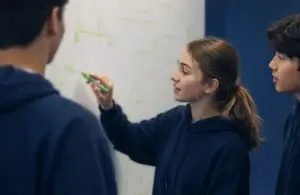

Studying effectively means replacing passive review, like rereading and highlighting, with active recall and spaced repetition, the two methods with the strongest research support for long-term retention. A structured routine built around these techniques produces stronger results in less total time than cramming. Focus North Academy reinforces these methods directly inside every tutoring session.
How can you study more effectively than rereading or highlighting?
Studying more effectively than rereading or highlighting means replacing passive review with active recall, the practice of retrieving information from memory instead of looking at it again. Rereading and highlighting create a feeling of familiarity, which is easy to mistake for real understanding, but that recognition rarely holds up under exam conditions.
|
Study Habit |
Why It Feels Productive |
Why It Falls Short |
|
Rereading notes |
Familiar material feels understood |
Recognition is not the same as recall |
|
Highlighting text |
Marks feel like active engagement |
Passive marking does not build memory |
|
Cramming the night before |
Covers everything at once |
Skips retrieval and spacing entirely |
Active recall works because it forces the brain to reconstruct information rather than simply recognize it, and that reconstruction is what strengthens long-term memory. Closing the textbook and writing down everything remembered, then checking for gaps, does more in ten minutes than an hour of rereading.
What is the most effective study method for exams?
The most effective study method for exams combines active recall with spaced repetition, reviewing material at increasing intervals over time instead of all at once. This pairing consistently outperforms single-session cramming in controlled studies, because spacing forces the brain to retrieve information right before it would otherwise be forgotten, which is the point at which memory strengthens most.
For subjects with heavy multi-step content, such as Grade 11 functions or trigonometry, spacing also allows a student to notice which specific step keeps causing errors across multiple review sessions, rather than losing that pattern in a single long cram session.
How do you build an effective study routine step by step?
Building an effective study routine step by step means structuring sessions around active recall and spacing rather than open-ended review time. The following sequence turns the research into a routine a student can actually follow.
Step One: Study the material once, actively. After a lesson, summarize the key points in your own words or make flashcards, rather than simply rereading the textbook or notes.
Step Two: Review the next day without notes. Close the material and write down everything you remember, then check what was missed. This first recall session locks in what is stuck and flags what needs more attention.
Step Three: Space out further reviews. Revisit the same material a few days later, then again about a week after that, mixing in older topics each time rather than reviewing only the most recent material.
Step Four: Use short, focused blocks. Study in sessions of twenty-five to fifty minutes with a clear break between them, since sustained focus during a shorter block produces better recall than several unbroken hours.
Step Five: Test under exam-like conditions before the exam. Practice questions or past papers without notes build the retrieval skill in the same format the actual exam will require.
Which study techniques work best for different subjects?
The study techniques that work best depend on whether a subject is fact-based or multi-step. Fact-heavy material, such as vocabulary or definitions, responds well to flashcards and spaced repetition. Multi-step subjects like math benefit more from rebuilding full problems from memory, since Grade 11 math mistakes usually trace back to one specific step rather than a lack of overall understanding.
Students preparing for a specific test can also apply this routine directly. A Grade 11 math exam benefits from the same spaced, recall-based approach, adjusted to the exact topics that exam will cover.
The Feynman technique, explaining a concept in simple terms as if teaching someone else, is especially effective for identifying gaps in multi-step subjects, since any point where the explanation breaks down reveals exactly where the understanding is incomplete.
How does tutoring reinforce effective study habits?
Tutoring reinforces effective study habits by giving a student real-time feedback on whether their study methods are actually working, not just on whether an answer was right. A tutor can catch a student relying on rereading instead of recall and redirect the session toward active retrieval immediately. Private math tutoring sessions at Focus North Academy build active recall directly into the structure of each appointment.
Written session feedback after every session also documents which study strategies produced the strongest results for that specific student, which helps refine the study routine over time rather than repeating whatever felt productive in the moment.
Frequently asked questions
1. What is the best way to study for a test in one week?
The best way to study for a test in one week is to space out review sessions across the available days rather than concentrating all studying near the end. Begin with active recall on the full material early in the week, then revisit it every one to two days, mixing in earlier topics as the test approaches.
2. Is rereading notes an effective way to study?
Rereading notes is one of the least effective ways to study because it builds familiarity without requiring the brain to retrieve information. Active recall, closing the notes and writing down what is remembered, consistently outperforms rereading for both understanding and retention.
3. How long should a study session be for high school students?
Study sessions of twenty-five to fifty minutes, followed by a short break, tend to produce the strongest focus and retention for high school students. Several shorter focused blocks across a few days generally outperform one long unbroken study marathon.
4. What is spaced repetition and how does it help studying?
Spaced repetition is a study method that reviews material at increasing intervals over time instead of all in one sitting. It helps studying by prompting the brain to retrieve information right before it would be forgotten, which is the point at which memory is strengthened most effectively.
5. Can a tutor help improve how a student studies, not just their grades?
Yes, a tutor can directly improve how a student studies by observing their current habits and redirecting them toward active recall and spaced review in real time. Improved study habits often produce grade gains as a secondary result, but the study skill itself carries forward across every future subject.
Turning study time into real results
Effective studying is less about the number of hours spent and more about whether those hours involve real retrieval. Replacing rereading and cramming with active recall and spaced repetition consistently produces stronger results in less total time, and the habit carries forward into every future course.
If your student is putting in study time without seeing the results to match, the method may be the missing piece rather than the effort. Focus North Academy builds active recall and structured review directly into every session, with written feedback after each appointment to track what is working. Book a consultation with Focus North Academy to build a study routine around how your child actually learns.
Key takeaways
- Active recall, retrieving information from memory, consistently outperforms passive review methods like rereading and highlighting.
- Spaced repetition reviews material at increasing intervals and strengthens memory right before information would otherwise be forgotten.
- Short, focused study blocks of twenty-five to fifty minutes produce stronger retention than long, unbroken study sessions.
- Multi-step subjects like math benefit from rebuilding full problems from memory rather than only reviewing final answers.
- A tutor can observe a student’s current study habits and redirect them toward active recall and spacing in real time.